

The GUI Is Dead. Long Live the API. — A Reality Check on the State of SaaS Innovation
Most SaaS vendors are still shipping like it's 2019 — while a non-coder with Claude Code can spin up a working app in two hours. The gap between what buyers now expect and what most vendors deliver is widening fast. Here's what that means for Solution Engineers who plan to still be relevant in 24 months.
Spoiler: It's Complicated
The easy story about SaaS innovation right now goes something like this: AI is amazing, everyone is shipping faster than ever, the future is bright.
The actual story is messier. Some vendors are racing ahead. Others are about to die. Buyers' expectations have jumped a generation in 18 months. Most SaaS companies haven't noticed. And SEs sit in the middle — trying to make the whole stack actually work for customers who are now, in some cases, more AI-fluent than the vendor's own product team.
That's the conversation Tim and Jan have on this episode. Below is the part you can act on.
Innovation Fatigue Is Real — Even for the Early Adopters
Jan opens with a confession: he's the kind of person who hunts down every new tool the day it ships. And he's tired.
"I finished setting up a brand-new Claude Code workflow last week. Then OpenAI dropped Codex on the next level. Now I want to tear it all down and rebuild. At some point you have to stop rebuilding the toolset and actually do the work." — Jan-Erik Jank (paraphrased)
If the people who like the chaos are feeling whiplash, imagine the average SE manager being told to "do something with AI" while also hitting quota, fixing their hiring pipeline, and rolling out a new demo platform.
The pace isn't going to slow down. But it does change the question for SE leaders: what do you actually commit to, versus what do you watch? You can't ship the latest tool every week and also build a team.
Non-Coders Can Now Ship Real Products. That Changes Everything.
Here's the moment that broke the conversation open. Jan — a self-described non-programmer — built a working app in roughly two hours: database, cloud, authentication, the works. He didn't write a line of code by hand.
The implication isn't "everyone is a developer now." The implication is much sharper than that:
"If I can build this in an afternoon, what should the people who actually know what they're doing be capable of? And why can't the SaaS companies I pay every month deliver at that pace?" — Jan-Erik Jank (paraphrased)
Once you've shipped something yourself with AI assistance, your patience for quarterly release cycles collapses. Your tolerance for "we'll add that to the roadmap" collapses. Your willingness to wait six months for a basic API field collapses.
And here's the kicker: your customers are doing the same math. They're using Claude or ChatGPT every day. They know what's possible. When they sit across from your AE, they aren't impressed that your product has "AI features." They're wondering why your product still feels like 2019.
Two New Buying Criteria That Should Worry Every SE
Tim shared the two questions he now uses to evaluate any SaaS vendor he's considering buying from. They're worth stealing — both as a buyer and as a check on your own product.
Tim's New Vendor Filter
- Don't show me your roadmap. Show me your last six months of release cycles. Roadmaps are wishlists. Release history is the only honest predictor of what you'll actually deliver in the next six months.
- Do you have a usable API or MCP server I can talk to without going through your GUI? If your API sits behind an Enterprise plan upcharge, that's a red flag. Your GUI is just a human interface to your API anyway — locking the API away is locking customers out.
Try this exercise: answer those two questions about your own product. Honestly. If the answer is "uh," that's where the next two years of your competitive risk lives.
The GUI Is Dead. Long Live the API.
This was Jan's provocative WhatsApp status from earlier this month, and it framed the rest of the conversation.
The current SaaS stack assumes a human jumping between isolated containers. Pop into the call recorder. Switch to the CRM. Open the email tool. Build the deck. Generate the quote in the CPQ. Five logins, five interfaces, five different sets of buttons.
The next stack assumes an orchestrator. One agent (Claude Code, increasingly your own product) talks to everything else via API and MCP. The human supervises and steers — they don't click.
You can already see which vendors get this and which don't. Salesforce announced "Headless 360." Anthropic ships MCP servers as a first-class artifact. Meanwhile other vendors are charging Enterprise rates just for API access — despite the fact that the buyer building the prototype is a two-person team on the cheap plan.
"I communicate with a black hole. I open a ticket, six weeks later something maybe happens. Meanwhile I could have built half of what I asked for myself. If you keep shipping at this pace, I already know you're going to be off the market." — Jan-Erik Jank (paraphrased)
Some vendors will collapse into a single search-bar interface in front of a smart orchestrator. Others will become invisible backends. A lot of today's logos won't exist in five years — and the ones that survive will be the ones whose API is a first-class citizen, not a paywalled afterthought.
"AI-First" Is a Sticker, Not a Strategy
One of the most repeated frustrations in the episode: vendors slapping "AI-first" above the fold while the actual product still lacks basic field-level customization.
"Fix the f*cking basics. Add the standard fields to your weird API. That would help me more than any fancy AI bullshit bingo." — Jan-Erik Jank (paraphrased)
The hypothesis is brutal but probably accurate: a lot of "AI-first" rebranding is driven by the fact that buyers now have a separate AI innovation budget. If you slap "AI" on the landing page, you qualify for the new line item. That's it.
AI is a means to an end. If you can solve a customer's problem with it — fair enough. But "we use Microsoft Teams, therefore we're an AI company" is not a strategy. And buyers can tell the difference.
What This Means for SEs: Speed Is Table Stakes. Conversations Are the Moat.
Here's where the episode lands its most important point for the SE audience.
The demo work that used to take 2–3 days to prep — finding the right industry data, configuring the right scenario, branding the deck — is collapsing toward zero. With MCP servers, API-driven provisioning, and demo-automation tooling, generating a tailored demo is increasingly an instant operation.
But automation only works if the input is right. Jan quoted his old professor: shit in, shit out.
The New SE Equation
If your value as an SE was defined by your ability to prepare a demo, that value is approaching zero. If your value was defined by the quality of the discovery conversation that determined what demo to build — the pain you uncovered, the industry context you mapped, the problem awareness you triggered — that value is going up.
The Trusted Advisor positioning we've been preaching for years isn't suddenly obsolete. It's the opposite. Automation kills the part of the SE job that was always low-leverage (manual demo prep). It elevates the part that was always the moat (discovery, pain validation, business case).
Consensus announced this month: "Let your product do the talking. Transform your static content into interactive AI agents that give personalized demos, answer questions, and capture intent 24/7." If you define your job as "the person who runs the demo," that announcement is a layoff notice. If you define your job as "the person who figures out what the customer actually needs, so the right demo gets built," it's a force multiplier.
Why Liability Keeps Humans (and Real Vendors) in Business
One detour worth lingering on: Jan spoke to a friend at an auditing firm and asked the obvious question — what's left for you to do once an LLM can run the numbers?
The answer was sharp. The auditor's product isn't the audit. It's the liability transfer. The client pays not for the output, but for the signature on the bottom that shifts legal responsibility off their desk.
This is also why Harvey (legal LLM wrapper) is a billion-dollar company while a smart paralegal with ChatGPT is not. Same underlying capability. Different liability profile.
For SaaS vendors, the analog is: customers don't just pay for features. They pay for the implicit promise that someone is responsible when the system breaks at 3 a.m. on the night of the launch. That's a moat AI doesn't dissolve — but it also means vendors that can't actually deliver on that promise will get exposed faster than ever.
The Bubble Check: Mind the Gap
One honest moment in the episode: Tim and Jan acknowledge they live in a bubble. The state of SaaS innovation in their network looks very different from the state of SaaS innovation in most companies.
- At Jan's dentist, patient data updates still happen via clipboard.
- Somewhere in the Mittelstand right now, "our biggest digital project this year" is migrating from Lotus Notes to Outlook.
- Philipp Klöckner's recurring point on the Doppelgänger Podcast: if 20 years of "digitalization in the Mittelstand" didn't move the needle, why would AI?
But: the next generation will grow up AI-native. The kids being born this year will have been talking to LLMs their whole lives by the time they're in their first job. The lag is real — and so is the cliff at the end of it.
So What Do You Actually Do This Quarter?
The episode is mostly diagnosis — but here's what we'd lift out as concrete actions for SE leaders and senior ICs:
For SE Leaders
- Stop investing in manual demo prep. Invest in the infrastructure that lets demos be auto-generated — demo engineering, MCP/API integration, data fixtures.
- Audit your team's discovery quality. If automation handles the demo, discovery becomes the differentiator. Score your last 10 discovery calls honestly. Where's the gap?
- Give your SEs an environment to experiment. The teams that win the next two years won't be the ones with the best toolset — they'll be the ones whose people had time and permission to play.
- Apply Tim's two-question filter to your own product. Six months of release history. API/MCP access. If your own product fails the test, that's a strategic conversation to bring upstairs.
For Individual SEs
- Don't define yourself through the demo. If demo automation can replace what you do, you've been doing the wrong job. Anchor your identity in the conversation, not the deliverable.
- Build a prototype on top of (not inside) your product. Spin something up with Claude Code that uses your product's API. Use it as a conversation-starter with both customers and your own product team. It costs you a weekend and it changes how people see you.
- Sharpen your AI literacy. Not "I tried ChatGPT once." Actual fluency — what's a token budget, what's an MCP server, what's actually different between Claude and Codex. Customers will start asking SEs these questions in 2026, and you should not be the one who doesn't know.
Bottom Line
The state of SaaS innovation isn't "amazing" or "broken." It's stratified. Some vendors are about to leap ahead. Many are about to be exposed. The buyer's expectations have already shifted — quietly, but permanently.
For SEs, the role isn't disappearing. It's bifurcating. The "demo doer" half is collapsing into automation. The "trusted advisor" half is the only half worth having a career in.
Yes, it's complicated. That's the spoiler. But complicated is good news for the SEs and SE leaders who are willing to actually engage with the shift — rather than wait for someone to issue a roadmap.
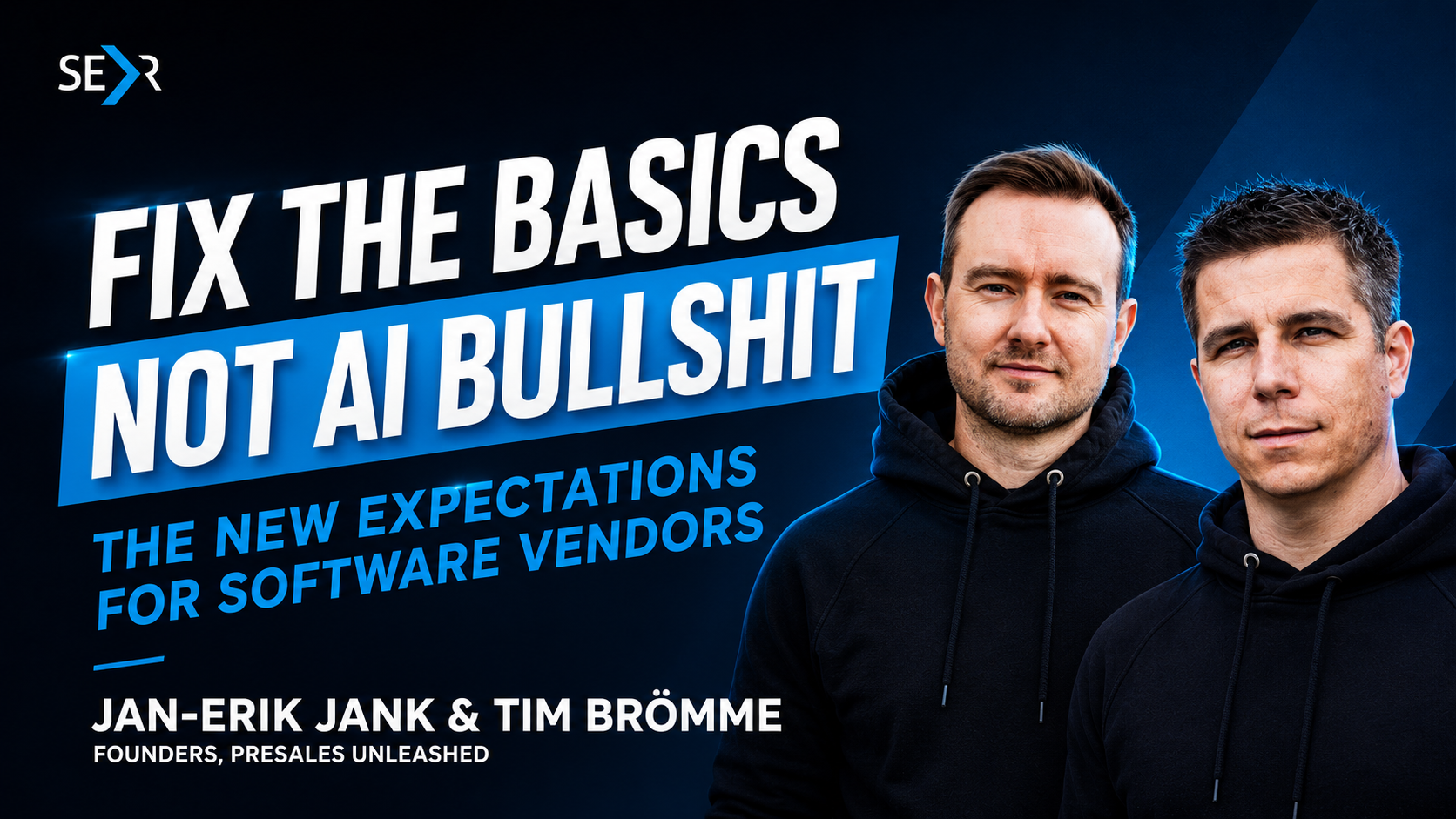
This article is based on Episode 260 of the PreSales Unleashed Podcast — "State of SaaS Innovation (Spoiler: Es ist kompliziert)" — hosted by Tim Brömme and Jan-Erik Jank, co-founders of SE Rockstars. Quotes are paraphrased English translations of the original German conversation.



.svg)