
A synthesis from a closed-door roundtable with a dozen enterprise SE leaders.
We put a room full of enterprise SE leaders together in Frankfurt, gave them no agenda, and asked one question: what does your team need tomorrow that it doesn't have today? Three hours later the answer was almost unanimous — and it had very little to do with the things solution engineers are usually hired for. AI is quietly eating the two pillars SEs built their careers on: deep technical knowledge and industry expertise. So what's left when the machine can out-research and out-configure you? The human stuff. Here's what the room agreed actually matters.
TL;DR
- AI is commoditizing what SEs were hired for. Domain research and product configuration are becoming machine work. The remaining moat is human judgment — and most teams aren't training for it.
- Five skills came up again and again: sharp discovery questioning, business acumen, stakeholder management, translating features into customer metrics, and leading change.
- The technical bar is spiking — then it will fall. POCs, MCP, agent-to-agent orchestration and frontend tinkering are in demand right now, but leaders expect tooling to close that gap. Don't over-hire for it.
- "Forward Deployed Engineer" is mostly a rebrand. The title matters less than the competencies that get a deal across the line.
- The real differentiator is organizational: the teams that win are the ones that learn fastest — and that know the difference between "I know" and "I can."
Why are the skills SEs need suddenly changing?
Because AI is collapsing the two things solution engineers were traditionally valued for: domain expertise and technical depth.
One leader put it bluntly. The market-knowledge specialists — people hired purely for deep knowledge of a sector — are becoming redundant. Why staff a dedicated finance-domain expert when any SE can ask a frontier model for sector-specific context, by country and by regulation, in seconds? The same pressure is hitting the KPI and business-value engineers whose calculations a model now drafts faster, with nicer charts.
But here's the twist the room kept circling back to: as the commodity skills get automated, the scarce ones get more valuable, not less. "People buy from people" stopped being a cliché and became a strategy. Several leaders noticed customers actually want more human contact now — pulling the CIO into the room for fifteen minutes, asking for the person behind the polished demo. When everything is glossy and automated, the human is the differentiator.
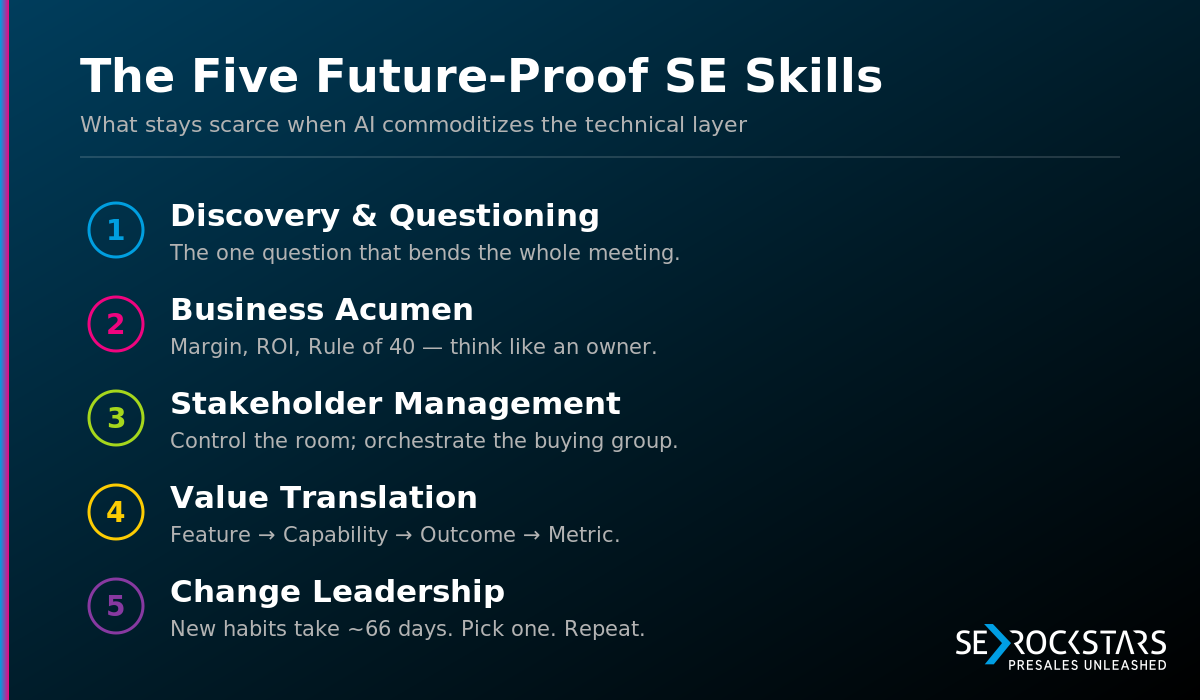
The five human skills SE leaders expect to matter most as AI absorbs the technical work.
If you could build one SE skill first, what would it be?
Discovery — specifically, the craft of asking the question that changes the room.
This was the single most-cited skill of the session. One leader who runs a team selling a complex, multi-stakeholder enterprise platform described spending two years deliberately working on his own questioning technique. The payoff, in his words: you sometimes ask one extremely good question in a meeting, and the whole meeting takes a different turn.
And it isn't just asking — it's caring why. When a customer hands you ten use cases out of a hundred, those ten are the ones that matter. The future-proof SE doesn't rush to build; they ask why this use case, what the underlying value is, where the payoff actually comes from. AI can enrich that prep. It cannot supply the genuine curiosity that makes a buyer open up.
Why does business acumen keep tripping up European SEs?
Because too many SEs still think like technologists instead of like owners of a business — and in Europe, leaders say, that gap is especially wide.
One leader who has run global teams was blunt about the contrast: American presales reps, out of the box, can talk margin, profitability and financials without flinching. European SEs tend to freeze.
"I don't know how often I go into a deal with my people — total tech nerds — and have to say: stop the bus. Do you actually work for us as a company? Are we trying to earn a profit here, or are you arguing like we're a charity?"
He told a story about flying out to sit with his team and walking them through the Rule of 40 — the SaaS heuristic that a healthy company's revenue growth rate plus its profit margin should add up to 40% or more — and how investors actually make money on a business like theirs. Suddenly the lights went on: pricing decisions, product strategy and restructuring all made sense. Business acumen isn't a nice-to-have. It's the bridge between "what the product does" and "why the buyer's CFO should care."
How do you move a team from feature dumping to selling value?
With a repeatable bridge and relentless repetition — not a one-time "sell value" pep talk.
The room's favorite mechanism was dead simple: Feature → Capability → Outcome → Metric. For every feature an SE wants to show, push the thinking one step to the right. The further right you get, the more interesting it becomes — and the further from generic.
"We're more efficient" isn't an outcome. How much more efficient? Where does the customer stand today — 27.5%? Against what benchmark? The goal is a statement so specific it only fits the one customer in front of you. As one leader put it: if you can copy your compelling-event statement from one opportunity to the next and it still reads true, it's worthless.
A second, practical rule from the same conversation: no more than two or three use cases per demo. The enemy is the "harbor tour" — the aimless product walk-through where the SE clicks through features hoping something lands. Better to explain the metric and the outcome before you say where you're about to click. And none of it sticks on the first telling. "Repetition, repetition, repetition," one leader said of weaning a senior team off the harbor-tour habit.
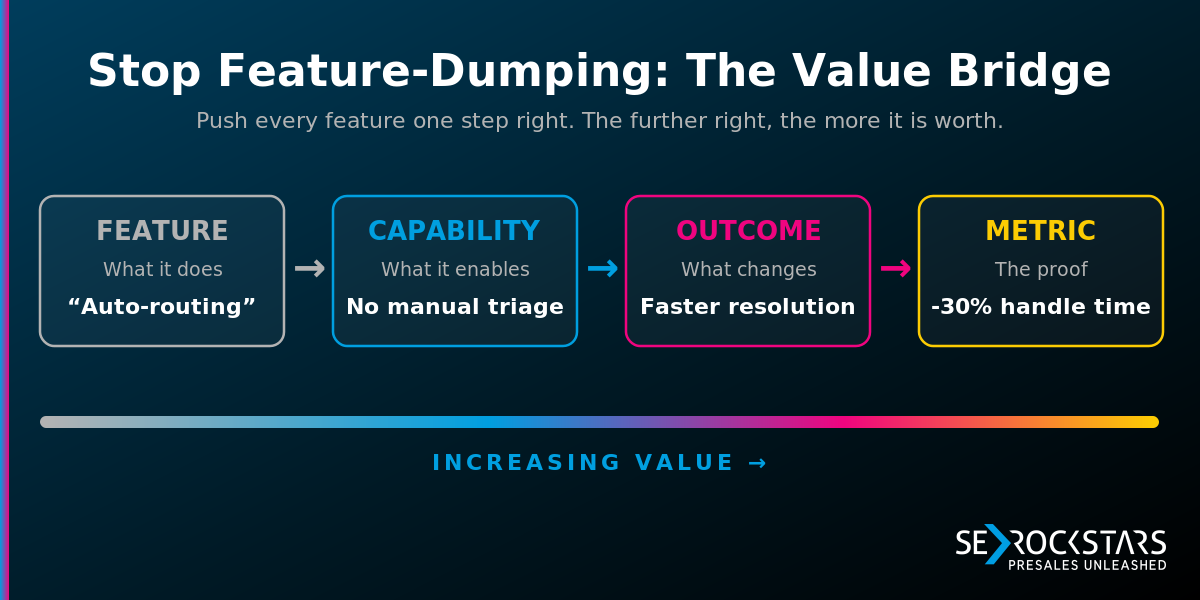
The value bridge: push every feature one step right — from what it does to a metric the buyer cares about.
Will AI replace the human part of presales?
No — but it will punish SEs who outsource their thinking to it.
Every leader in the room is a heavy AI user. They also see the failure mode clearly: generic AI discovery dressed up as insight.
"I can already tell when something's a hundred percent AI-generated. It's not your own thinking — it's just enriched. It looks fancy, with icons, and the moment we walk into the meeting it's completely beside what the customer actually expects."
AI is phenomenal for research, prep, drafting, translation and demo automation. But it hallucinates, it's hard to reproduce, and — as one leader found when his pipeline reporting went "AI-shiny" — half the underlying data didn't hold up. Treat it as augmentation on top of solid craft, not a replacement for it. The SEs who win the AI era are the ones whose communication and stakeholder management are sharp enough that the tool amplifies real judgment instead of papering over its absence.
What's the real future skill — and why isn't it an individual one?
It's organizational: how fast your team actually learns.
The session's closing synthesis reframed the whole conversation. Every thread — discovery, business acumen, AI, change — comes back to one question a leader posed: how does our organization learn? And he added the line that belongs on every SE manager's wall:
"There's a massive difference between 'I know something' and 'I can do something.'"
Knowing is cheap now. Doing — changing behavior — is the hard part, and it takes time. Behavioral research puts habit formation at roughly 66 days on average, not the "do it once and it sticks" fantasy. Which is why piling ten new expectations on a team at once fails: you don't change ten habits in parallel. Pick one. Reinforce it in one-on-ones, in deal reviews, in team calls, until people groan "here he comes again with that question." That groan is the sound of a habit forming.
The leaders who measure this — competencies tracked over time, peer feedback inside the team, accountability pushed down rather than hoarded — are the ones building teams that adapt faster than the tooling shifts underneath them. In a market this volatile, that's the only durable edge.
Frequently asked questions
What skills will solution engineers need in the age of AI? As AI commoditizes domain research and product configuration, the durable SE skills are human: sharp discovery questioning, business acumen, stakeholder management, translating features into customer-specific metrics, and leading behavior change. Technical literacy still matters, but judgment and communication are what AI can't replicate — and what buyers increasingly pay for.
Is technical knowledge still important for sales engineers? Yes, but its half-life is shrinking. The technical bar is spiking right now — POCs, agent-to-agent orchestration, APIs — yet most SE leaders expect tooling to close that gap within a few years. Build enough technical fluency to stay credible, but don't bet your entire hiring strategy on deep technical depth alone.
What is a Forward Deployed Engineer, and how is it different from an SE? A Forward Deployed Engineer embeds with a customer to bridge product capability and customer need, often building a working proof before a contract is signed. Most SE leaders see it as a well-paid rebrand of work presales already does. The competencies that close the deal matter far more than the title.
How do you train an SE team to sell value instead of features? Use a repeatable bridge — Feature → Capability → Outcome → Metric — and force every feature one step toward a specific customer metric. Cap demos at two or three use cases, explain the outcome before the click, and reinforce it in every deal review. Repetition, not a one-off workshop, is what changes behavior.
How long does it take to change an SE's behavior? Behavioral research puts habit formation at roughly 66 days on average, with wide individual variation. That's why trying to change ten behaviors at once fails. Pick the single habit that moves the needle, reinforce it consistently across coaching touchpoints, and expect real change in months, not days.
At the SE Rockstars Trusted Advisor Academy, these are exactly the muscles we train — not in a workshop people forget by Friday, but week over week on real deals, because behavior change takes reps, not slides.
By Tim Brömme & Jan-Erik Jank — co-founders of SE Rockstars, enterprise PreSales practitioners since 2010 and 2013, hosts of the PreSales Unleashed podcast, and coaches to 250+ solution engineers.