
Field notes from a closed-door roundtable with ten enterprise B2B SaaS SE leaders — on AI from the leadership seat.
Everyone in the room had the tools. Claude, ChatGPT, Copilot — pulled off the shelf, credits burning, the play instinct high. And yet, as one leader admitted, "we're mostly doing the same things as before, just faster." That was the honest starting point. The interesting conversation wasn't about which model is best. It was about what actually changes when an SE leader puts AI to work running a team and a pipeline. Three threads kept surfacing: context, the operating model, and the choice between efficiency and depth.
TL;DR
- The tools are commoditized; context is the bottleneck. AI is only as smart as the scattered data you can feed it — the "octopus" of CRM, transcripts, email, chat, and 1:1s. Wrangling that is the leader's real job now.
- Stop optimizing for efficiency. Optimize for depth. The sharpest leaders are using AI to "shift left" into deeper discovery and to aim scarce human attention at the deals they can actually win.
- The unlock is an operating model, not an app. Bottom-up beats top-down: shared skill repos, fortnightly build sessions, and "collect first, perfect later."
- Capture what good looks like. Pour your two or three best SEs' judgment into a reusable skill — near-instant onboarding, plus AI coaching that spots patterns over time.
- Beware the "thirteen pages from three bullet points" trap. Verbose, unvalidated output fools no one — least of all the customer, who runs your AI through their own AI. Human-in-the-loop is the moat.
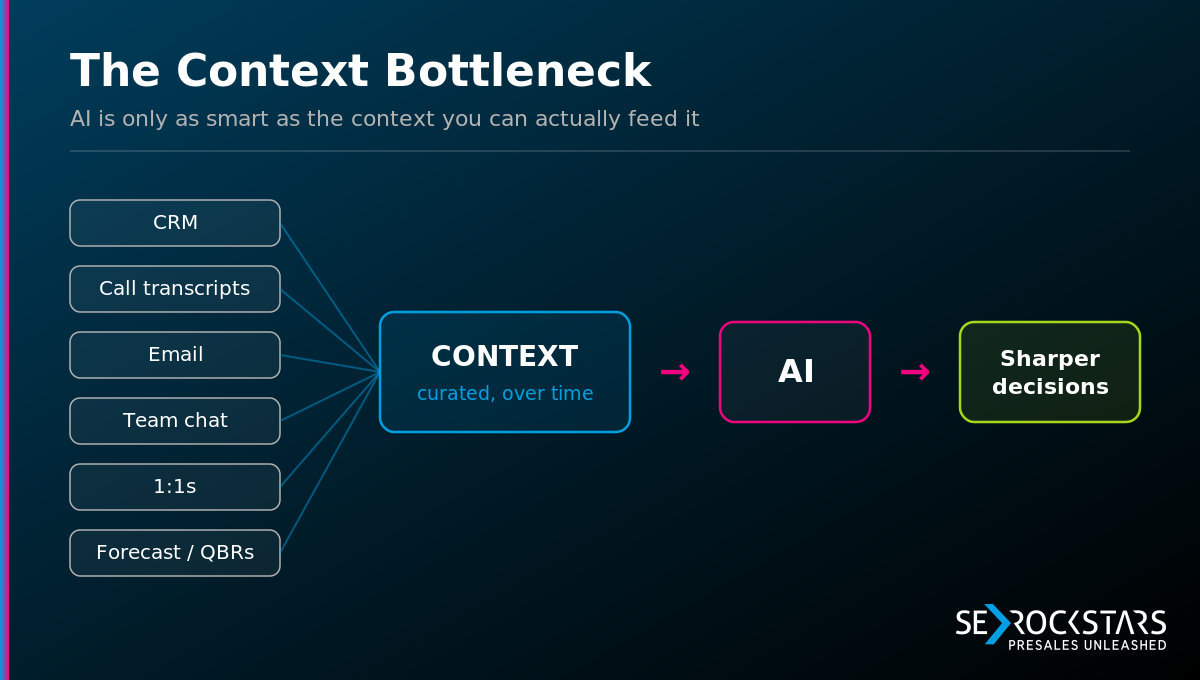
AI is only as smart as the context you can feed it — and pulling the islands together is the leader's job.
What's actually holding SE leaders back with AI — the tools, or something else?
Not the tools. Every team in the room already had three AI assistants. The real bottleneck is context: getting scattered information into a place where AI can actually use it.
One leader called it the octopus problem. The signal he needs lives in a dozen places at once — CRM, call transcripts, forecast calls, QBRs, hallway tips, plus the inbox and the team chats — and none of it converges.
"I look at 200 opportunities a quarter — pipeline, coverage, splits — and honestly, sometimes I just can't give the latest status. The information isn't only getting more complex, it's getting faster. That combination is the real challenge."
That's the leadership reframe: AI is brilliant once it has context and useless without it — a classic retrieval problem. Several leaders are now building "context over time": one wired up a raw-capture inbox feeding a weekly curation pass, where agents turn unstructured dumps into structured, searchable knowledge. His verdict after a few weeks? It works — but the quality climbs slower than you'd hope, and too much context is as bad as too little.
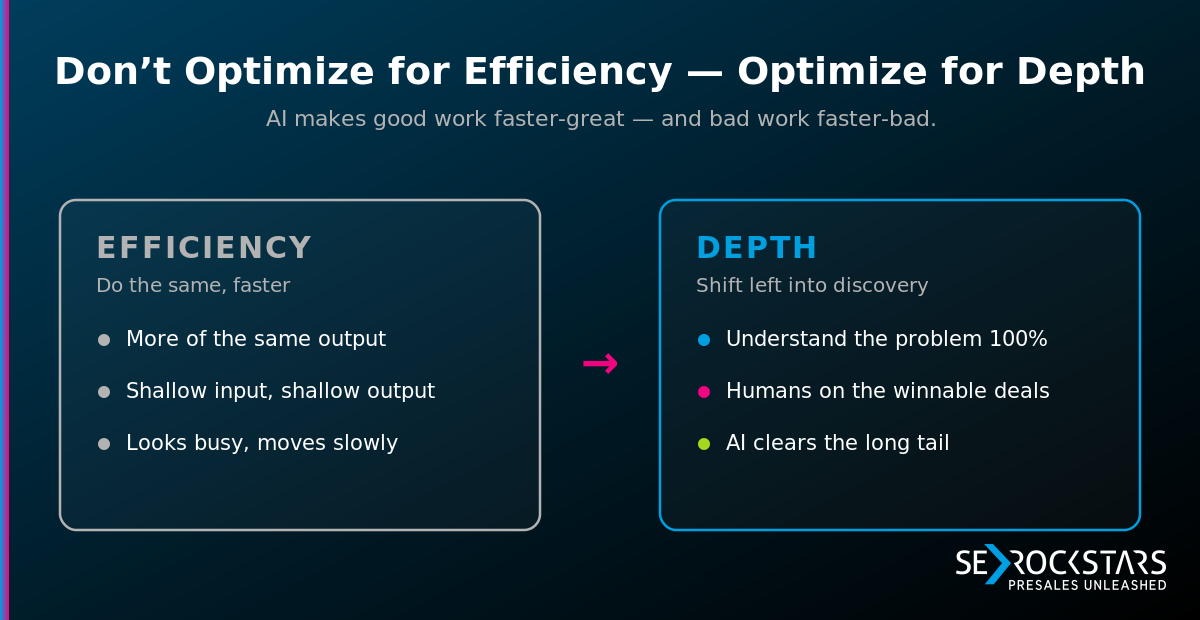
The reframe SE leaders kept making: don't optimize for efficiency, optimize for depth.
Should SE leaders use AI for efficiency, or for something more?
For depth. The most provocative line of the session was a flat rejection of the efficiency framing every vendor leads with.
"I don't actually want efficiency — I want depth. AI makes things faster because you just click. But garbage in, garbage out. So I want a brutal shift left: away from the demo, into much deeper discovery, until the team understands the customer's problem one hundred percent."
The logic is sharp. If you feed AI a shallow, half-understood problem, it confidently produces a shallow answer faster. If you feed it a deeply understood one, it accelerates real work. As one leader put it, AI makes good things faster-great and bad things faster-bad.
That reframes the leader's job from squeezing more output to allocating human intelligence. Put your scarce SE attention on the deals you can genuinely win, and let AI knock out a fast, "good-enough" first pass on the long tail of low-attention deals nobody was servicing well anyway.
Why do AI-generated deliverables keep falling flat?
Because volume isn't validation. The cautionary tale of the night: an SE turned three bullet points from a customer call into a polished document with AI.
"Three bullet points went in, and thirteen polished pages came back. It wasn't bad — but it was bla. And the customer gets that exact same output from everyone."
The trap is that the output looks professional and complete, so the next person treats it as validated context — and builds on sand. Worse, the customer already knows. They're running your AI-generated deck through their own AI summarizer. The polish cancels out; the human judgment is what's left. The question the room kept circling back to wasn't "how do we generate more," but "how do we use AI to make the humans better?"
Top-down or bottom-up: how are leaders rolling AI out across a team?
Bottom-up, every time. "Think global, act local" came up more than once, and for a hard reason: corporate and IT are too slow. Ask IT to bolt a new skill onto an internal tool and you might wait four months — by which point there are three better approaches.
The operating model that's working looks less like a rollout and more like a team sport. A shared repository of skills and templates. A standing session every two weeks where the team decides what to build together, splits the work, and reviews whether it actually helped — instead of everyone tinkering in private. AI hackathons to pull the rest of the org in.
A quieter point of consensus: collect first, perfect later. One leader spent months just getting people to contribute their work into a common store before worrying about quality, using presales as a light quality gate. The bigger hurdle isn't technical — it's cultural. Pouring your personal edge into a shared skill so colleagues become as good as you is a mindset shift, not a deployment.
Can AI actually capture what your best SEs know?
Yes — if you treat your top performers as the source material. The pattern several leaders described: take your two or three best SEs, and iterate a skill with them roughly ten times — real transcripts and notes in, their corrections back — until it reliably produces "what good looks like."
The payoff shows up first in onboarding. A new hire can use that skill on day one and produce something 90% of the way there, then learn why it's good from the same system. That's a faster ramp than any playbook PDF.
Coaching is the other frontier — handled carefully. One leader connected an agent to a rep's full call history to surface strengths and suggestions, emotion-free and opt-in. The hard-won caveats: tune the prompt or it turns preachy; anchor it to a personality baseline so feedback fits the person; and never mistake it for human coaching. Its real gift is spotting patterns across many calls over time — not grading a single one.
What does an AI win in presales actually look like?
The wins that stick are small, human, and reusable — not moonshots. Two stood out.
The first: "proof stories." One leader had AI distill the company's case studies into 60-second, industry-tagged narratives — problem, fix, outcome, value — and asked every SE to memorize five or six. Now they open a call with "a company just like yours had this exact problem; here's how they solved it and what it was worth." It spread beyond presales to sales, ADRs, the services team, even marketing, because customers lean in within the first minute — and veteran SEs bored of repeating themselves finally got to go deeper.
The second: discovery-to-demo automation. Record the discovery call, let AI extract the use cases (a human validates them), then have an MCP-plus-skill provision a working demo environment — collapsing roughly five days of manual configuration into an afternoon. The leader's framing matters: it's not about replacing the demo, it's about freeing the team for the qualification only a human can do.
Frequently asked questions
How are solution engineering leaders using AI today? Less for flashy automation, more for leverage: wrangling scattered deal context, triaging which opportunities deserve human attention, capturing top performers' judgment into reusable skills, onboarding faster, and coaching from call-history patterns. The common thread is using AI to deepen human work, not just speed up existing tasks.
What's the biggest barrier to AI adoption in presales teams? Context, not tools. Most teams already have several AI assistants, but their data is fragmented across CRM, transcripts, email, and chat, so the model lacks what it needs to be useful. Leaders treat consolidating and curating that context — over time — as the core unlock.
Should SE teams roll out AI top-down or bottom-up? Bottom-up wins in practice. Corporate and IT move too slowly for a field that shifts every few months. The effective pattern is a team-owned skill repository, regular build sessions where the team decides and splits the work, and a "collect first, perfect later" approach to quality.
Can AI coach or onboard sales engineers? Partly. A skill built from your best SEs lets new hires produce strong work on day one and learn why. AI coaching can surface patterns across a rep's call history, but it gets preachy without prompt-tuning, needs a personality baseline, and can't replace a human coach — it augments one.
Does AI make SE demos and discovery obsolete? No. Demos are increasingly chat-driven and faster to build, but customers still buy from people. Deep qualification, problem discovery, and trust-building are exactly where AI can't substitute — so the smartest leaders are shifting effort toward them, not away.
At the SE Rockstars Trusted Advisor Academy, this is the conversation our SE-leader community has every week — not "which tool," but how to build the operating model and the depth that make AI worth the credits.
By Tim Brömme & Jan-Erik Jank — co-founders of SE Rockstars, enterprise PreSales practitioners since 2010 and 2013, hosts of the PreSales Unleashed podcast, and coaches to 250+ solution engineers.