
Scaling KPIs Without Scaling Admin

TL;DR
- When a KPI depends on people manually updating CRM fields, you're not measuring performance — you're measuring discipline and tolerance for admin work.
- That design has two predictable failure modes: adoption (SEs prioritize customers over data entry) and consistency (the same field means different things to different people).
- The fix isn't more nagging or a better dashboard. It's a principle: instrument the workflow, not the people. Capture signal as a by-product of real work.
- Automation (Make, n8n, Zapier) and conversation intelligence can pull structured insights from calls and emails, suggest field updates with confidence scores, and sync them to the CRM with a lightweight confirm-or-correct prompt.
- This is the only version of a KPI system that survives contact with a growing team. Manual capture scales linearly with headcount; instrumented capture scales with the work that's already happening.
Ask a Sales Engineering leader why their dashboard is wrong and, more often than not, the answer isn't about the metrics. It's about the CRM underneath them. "We treat Salesforce a bit like a stepchild," one solution engineering leader at a cybersecurity company in the DACH region told us. "A lot of stale deals get dragged along for a long time. We have deals that are north of 1,000 days old. You just scratch your head and think — you can't do anything useful with that data."
That's the quiet killer of PreSales measurement. You can pick the right KPIs, split the Technical Win from the Commercial Win, pair every metric with a counter-metric — and still end up with a dashboard nobody trusts, because the data feeding it depends on busy people remembering to type things into fields. The deeper you scale a team, the worse this gets. So the final question in this series isn't which metrics to track. It's how to capture them without turning your best SEs into data-entry clerks.
Why do PreSales KPIs break as a team scales?
Because most KPI systems are built on manual data entry, and manual data entry doesn't scale — it accumulates debt.
Here's the mechanism. Every KPI that depends on someone updating a CRM field is really measuring three things at once: performance, yes, but also each person's discipline and their personal tolerance for admin work. Stack a team of ten on top of that and you get two failure modes that compound with every new hire.
The first is adoption. Even your strongest SEs will always prioritize customer-facing work over CRM hygiene — and they're right to. So you, the leader, end up re-explaining the "why," nudging people to update fields, and chasing compliance after the fact. That's not a one-time onboarding cost. It's a permanent tax on your week that grows with the team.
The second is consistency. Shared fields rarely mean the same thing to everyone. What one SE marks as a completed MEDDPICC element or a "strong" compelling event, another would call partial or unproven. The result is noisy data, fragile dashboards, and KPIs that slowly lose credibility. Leaders stop trusting the numbers, and the numbers stop driving behavior. It's the same death spiral we covered in Part 1 — except here it's self-inflicted, by design.
The real problem: you're measuring tolerance for admin, not performance
Put it in one line: a KPI that depends on manual entry is a measurement of who's willing to do paperwork, not who's good at the job.
The leaders we talk to feel this acutely, even when they can't quite name it. One solution engineering manager at an IT services and systems-integrator firm in the Nordics, asked what his single biggest measurement obstacle was, didn't hesitate:
"Trying to get our AEs to be better at CRM — that's the challenge." — SE Manager, IT Services / Systems Integrator, Nordics
That's the whole problem distilled. The bottleneck on his metrics isn't analytical. It's behavioral. The numbers will only ever be as good as the least-disciplined person filling them in — and no amount of dashboard sophistication fixes a data-entry problem. You can build the most elegant Technical Win Rate report in the world; if the underlying fields are half-empty and half-wrong, you've built a beautiful instrument calibrated to noise.
And the irony is cruel: the SEs whose contribution you most want to capture are exactly the ones too busy closing deals to log it. The data gap is widest precisely where the performance is highest. So your dashboard systematically under-represents your best people and over-represents your most compliant ones. That's not a metrics problem you can report your way out of.
What good looks like: instrument the workflow, not the people
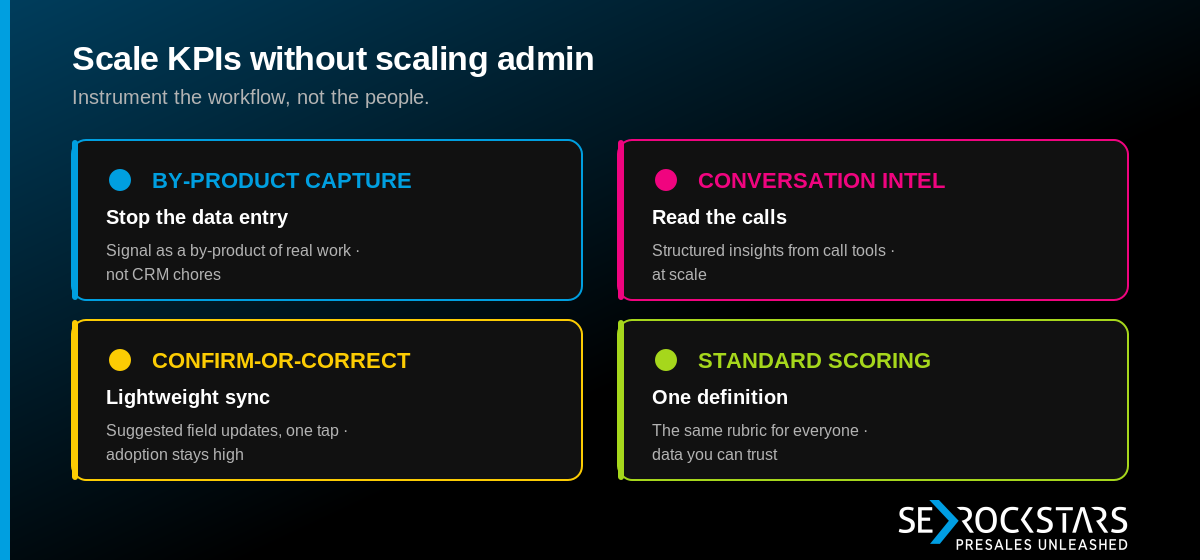
The shift that fixes this is small to state and large in effect. Stop asking the team to report the signal. Capture it as a by-product of work they're already doing.
The work is already generating the data. Discovery calls, demos, follow-up emails, recap notes — every one of those contains the raw material for half your KPIs: what pain was uncovered, which stakeholder showed up, whether success criteria were defined, what the next step is. The problem was never that the signal didn't exist. It's that we asked a human to transcribe it into a form field after the fact, and humans are bad at that and resent it.
Two categories of tooling change the economics here.
Automation platforms — Make, n8n, Zapier — stitch your stack together so that an action in one system updates another without anyone touching a field. A calendar event with a customer triggers a meeting record. A demo booked moves a stage. A proposal sent timestamps itself. None of it requires an SE to remember anything.
Conversation intelligence goes deeper. It can pull structured insights directly from calls and emails, suggest field updates with a confidence score attached, and sync them into the CRM behind a lightweight confirm-or-correct prompt. The SE isn't entering data — they're glancing at a proposed update and tapping yes or fixing one word. That's the difference between a chore and a reflex.
When capture is automatic and scoring is standardized, both failure modes close at once. Adoption goes up, because there's nothing onerous to adopt. Consistency goes up, because the machine applies the same definition of "strong compelling event" every time, instead of ten SEs each applying their own. The data quality improves and the admin burden drops — at the same time, which almost never happens in operations.
The adoption trap: instrumenting tools your team won't use
A caution, because this is where the strategy most often fails. Conversation intelligence only works if the conversations actually flow into it — and that adoption is far from guaranteed. One solution engineering leader at a cybersecurity company in the UK was blunt about how patchy it gets across regions:
"The Gong uptake in international has not been very good. It's the reps that don't do it. GDPR, all that nonsense I would say. Germany specifically is the worst — they all think everyone's out to get them, so we just have to go through a re-education part of that." — SE Leader, Enterprise Cybersecurity, UK & Ireland
This is the catch hiding inside "instrument the workflow." If the recorder isn't on, there's no signal to capture, and you're back to manual entry — or worse, a dashboard that silently under-counts the exact regions where adoption is weakest. Instrumentation doesn't eliminate the human factor. It relocates it: from will they fill in the field? to will they let the tool run in the first place?
The relocation is still a win — getting a tool switched on once is a far easier behavior to drive than getting a field updated after every call, forever — but it's not free. It demands real change management, honest answers on data privacy (especially in GDPR-sensitive markets), and a clear story about who sees the data and why. Treat the rollout as a trust problem, not a compliance problem, and the re-education that leader described gets a lot shorter.
A concrete example: from chasing fields to confirming them
Picture a 12-person SE team trying to track POC success-criteria coverage — a leading indicator from Part 1 worth a lot, because POCs that start without defined success criteria are the ones that quietly fail.
The manual version: after every POC kickoff, the SE is supposed to open the opportunity and fill in a "success criteria defined?" field plus a free-text summary. In practice, maybe 60% of them do it, the summaries are inconsistent, and the leader spends Friday afternoons pinging people for the missing 40%. The resulting "coverage" metric is really a measure of who answered the leader's Slack nudges. It tells you nothing reliable about deal health.
The instrumented version: conversation intelligence transcribes the kickoff call. An automation routine scans the transcript for success-criteria language, drafts a structured summary, and pushes a single prompt to the SE: "I detected 3 success criteria for this POC — confidence 0.82. Confirm or correct?" The SE taps confirm, or edits one line, in ten seconds. The field is now populated for 100% of POCs, with a consistent definition applied by the same model every time. The leader's Friday afternoon is free, and — this is the real payoff — the coverage metric finally means what it claims to mean.
Same KPI. Opposite outcome. The only thing that changed was who did the capturing.
Why this matters now
Because the cost of the old way is now visible in two directions at once.
Look back at that 1,000-day-stale-deal quote. Bad CRM hygiene doesn't just produce missing data — it actively poisons the metrics you do have. Stale deals inflate cycle-length averages, distort win rates, and corrupt every report built on top. The leader who flagged it has lots of data and can't use any of it, which is arguably worse than having none, because it manufactures false confidence.
And look forward. This is the natural endpoint of the AI shift reshaping PreSales right now. The same conversation intelligence that captures KPI signal is the same tooling transforming discovery, demo prep, and follow-up across the function. Instrumenting your metrics isn't a separate initiative bolted onto your AI roadmap — it's the same initiative, viewed through a measurement lens. The teams getting this right aren't running two projects. They're capturing performance signal as a free by-product of the AI workflows they were going to build anyway.
That's the whole point of this series in one move. You don't earn a trustworthy KPI system by demanding more discipline from people who are already maxed out. You earn it by designing the discipline out of the loop — so the data shows up because the work happened, not because someone remembered to write it down.
Frequently asked questions
Why shouldn't I just enforce CRM discipline more strictly? Because enforcement scales linearly with effort and never finishes — you're permanently policing behavior against people's natural incentive to prioritize customers. Even when it works, you're measuring compliance, not performance. Instrumenting the workflow removes the behavior you'd otherwise be policing, which is cheaper and far more durable than enforcement.
What tools do I need to instrument PreSales KPIs? Two categories. Automation platforms (Make, n8n, Zapier) sync actions across your stack so records update without manual entry. Conversation intelligence (Gong, Chorus and similar) extracts structured signal from calls and emails. The combination captures most leading indicators as a by-product of work the team already does.
Doesn't AI-captured data introduce errors of its own? It can, which is why confidence scores and confirm-or-correct prompts matter. The SE reviews a proposed update rather than entering it cold — fast, but human-checked. Crucially, the AI applies one consistent definition across the whole team, eliminating the interpretation drift that makes manual, multi-person data entry so noisy in the first place.
How do I get the team to actually adopt conversation intelligence? Treat it as a trust problem, not a compliance mandate. Be transparent about who sees the data and why, address privacy concerns directly (especially in GDPR-sensitive markets), and show SEs the personal upside — less admin, fewer manual updates. Adoption fails when it feels like surveillance and succeeds when it feels like leverage.
This is Part 8 of a 10-part series on PreSales performance measurement, drawn from the PreSales KPI Playbook and hundreds of conversations with solution engineering leaders. The Trusted Advisor Academy helps PreSales teams turn frameworks like this into everyday practice — including the operating model that makes instrumented KPIs stick.
About the authors: Tim Brömme and Jan-Erik Jank are the co-founders of SE Rockstars and the Trusted Advisor Academy. Between them they bring 30+ years of enterprise PreSales experience, eight-figure closed deal portfolios, and 350+ solution engineers coached.
This isn't just a training. It's rewiring how your team operates.
100% free | No commitment required



.svg)