
The Metrics Gap: Why Most PreSales Teams Are Measured Wrong


TL;DR
- Most PreSales teams are measured on the wrong things: either raw activity (demos delivered) or a commercial win rate they don't fully control.
- The core problem is a confusion of activity with impact — they are not the same, and optimizing the first quietly degrades the second.
- The fix starts with one distinction: separate the Technical Win (which the SE owns) from the Commercial Win (which they don't).
- A credible KPI system spans four lenses — leading, lagging, operational, and qualitative — not a single number.
- Good metrics don't promise precision. They deliver clarity: which deals will close, and whether SE involvement is making them bigger or faster.
Ask a Sales Engineering leader how they feel about their metrics and you'll rarely get a shrug. You'll get a flinch. "I hate every single one of our metrics, always have done and always will do," one solution engineering leader at an enterprise cybersecurity company in the UK told us. His complaint wasn't that metrics exist — it was that the ones he's judged on are end-to-end win rates:
I keep saying, you can't mark us if we lose on price.
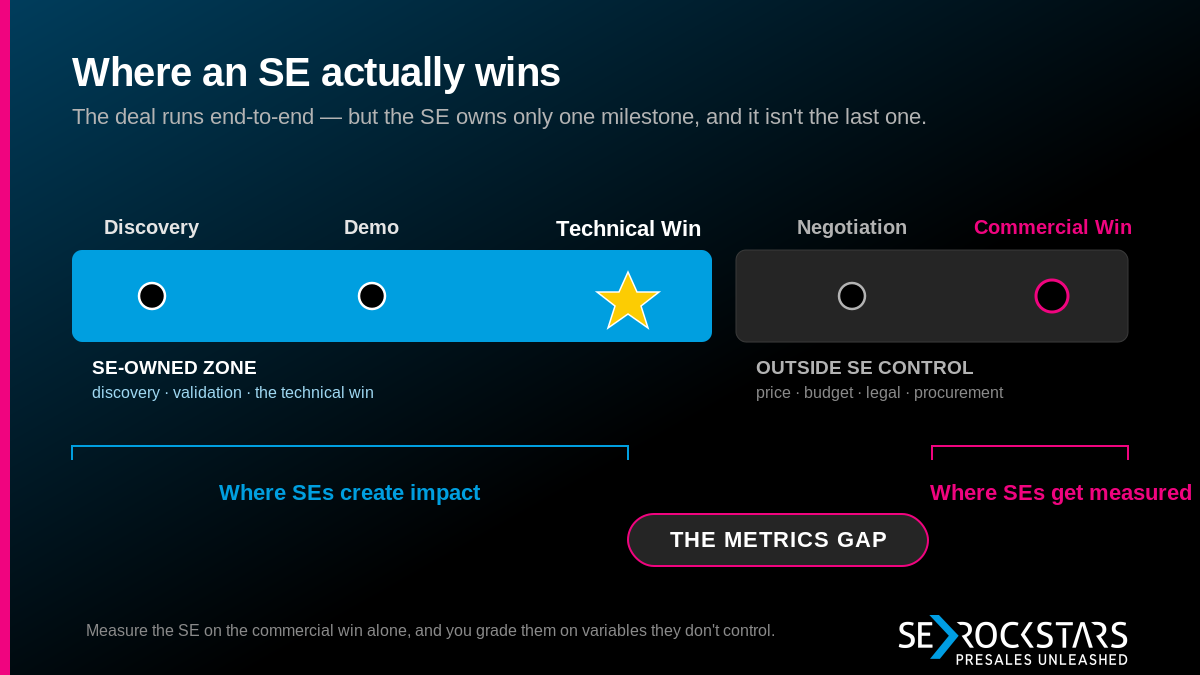
That sentence is the whole problem in miniature. PreSales sits in the middle of the funnel, owns a milestone it can win cleanly, and then gets graded on an outcome decided weeks later in a room it isn't in. This is the metrics gap. And until you close it, every dashboard you build will measure motion instead of contribution.
Why are PreSales metrics so often wrong?
Because most teams measure one of two things, and both are misleading on their own: activity or commercial outcome. Activity metrics (demos delivered, calls attended, hours logged) are cheap to count and easy to game. Commercial metrics (revenue, quota, win rate) are real but lag the SE's actual work by weeks or months and fold in pricing, legal, and procurement that the SE never touched.
Neither tells a manager what they actually need to know in the moment: is this person working on deals that will close, and is their involvement changing the outcome?
Historically the SE was treated as support, so we measured utilization — are my people busy? But the modern SE is a strategic partner responsible for the Technical Win, the point where a prospect confirms the solution meets their needs and beats the competition. The question shifts from "Are they busy?" to "Are they winning the right deals, and making them bigger?" Most measurement systems never made that shift. The role evolved; the scorecard didn't.
The real problem: activity is not impact
Here's the trap in one line: high activity is operationally expensive and strategically meaningless without context.
An SE running at 110% capacity on low-quality opportunities isn't a high performer — they're accelerating the organization toward a missed quarter, efficiently. Demo volume feels like productivity. It is not the same as progress. Roughly half of all proof-of-concept evaluations fail to convert, which means a team can be relentlessly busy delivering POCs and still be leaking pipeline because the qualification underneath was thin.
The cost of getting this wrong has gone up. As SaaS shifted from "growth at all costs" to efficient growth, the SE organization landed under the microscope — Sales Engineering is among the most expensive resources in the go-to-market motion. When finance starts asking what that investment returns, "we did 400 demos" is not an answer. It's an admission that you've been counting the wrong thing.
What good looks like: split the Technical Win from the Commercial Win
The single most useful move in PreSales measurement is to stop blending two different events.
The Technical Win is the SE-owned milestone: requirements validated, success criteria met, solution acknowledged as the best technical fit. The Commercial Win is the closed-won deal — and it can be lost on price, timing, or budget freeze long after the SE has done flawless work. Measure the SE only on the commercial outcome and you punish them for variables outside their control.
Track the Technical Win Rate separately and two things happen. You get a clean read on SE effectiveness — product fit and evaluation execution — uncontaminated by commercial noise. And you get an early-warning signal: a strong technical win that still loses commercially points at a sales or pricing problem, not an SE one. That's a coaching conversation in the right direction instead of the wrong one.
The four lenses of a credible KPI system
No single metric runs a PreSales team. A system that holds up under scrutiny covers four perspectives, and the rest of this series takes each one in turn:

- Leading indicators — which deals will close? Compelling Event quality, MEDDPICC compliance, multi-threading, POC success-criteria coverage.
- Lagging indicators — what did we actually deliver? SE-Attached Win Rate, Technical Win Rate, SE-attached revenue, average deal size with vs. without SE.
- Operational metrics — is capacity deployed well? Utilization, attach rate, AE:SE ratio, demo deflection.
- Qualitative metrics — how well was the work done? Discovery Quality Score, Demo Quality Score, internal AE-to-SE NPS, handoff completeness.
Leading indicators let you intervene before the quarter is lost. Lagging indicators validate the strategy and justify the headcount. Operational metrics keep the machine from burning out. Qualitative metrics turn "soft skills" into something observable and coachable.
Why this matters now
Because the alternative is invisibility — and PreSales leaders are feeling it. "Otherwise you can't demonstrate the effort you're putting in," one SE manager at a cybersecurity company in the DACH region told us. "They need to see it." Without a defensible measurement framework, the team's contribution is a matter of faith, and faith doesn't survive a budget review.
Watch what happens without it. One SE leader at an enterprise ERP company in North America described trying to protect his team's headcount against a blunt 1:3 AE-to-SE ratio:
I positioned a big spreadsheet covering multiple metrics — including the fact that if you factor in the post-sales team, the effective ratio is more like 1:7 — and it still didn't win.
He lost the argument not because he was wrong, but because the organization had no agreed framework for valuing SE impact. He had data; he didn't have a system. That's the gap, and it's expensive.
A better starting point
You don't fix the metrics gap by adding more metrics. You fix it with a few principles, which the rest of this series builds out:
- Decouple activity from impact. Never report a volume metric without a quality or outcome metric beside it. "Busy" is not a result.
- Make the Technical Win your North Star. It's the outcome the SE actually owns, and it predicts the commercial win without being hostage to it.
- Pair every KPI with a counter-metric. Any number you optimize in isolation will get gamed. More demos pairs with demo-to-next-step conversion; shorter cycles pair with POC success criteria.
- Instrument the workflow, not the people. If a KPI depends on SEs manually updating CRM fields, you're measuring their tolerance for admin, not their performance.
The goal isn't a perfect scorecard — there's no flawless way to isolate SE contribution from the broader revenue system. The goal is clarity: knowing which deals are real, where the team's effort goes, and whether their involvement changes outcomes. In modern technical sales, that clarity is what separates an average PreSales team from one operating at the front of the field.
Frequently asked questions
What KPIs should I use to measure a PreSales or SE team?
Use a balanced set across four lenses rather than one number: leading indicators (Compelling Event quality, MEDDPICC compliance), lagging indicators (SE-Attached and Technical Win Rate, SE-attached revenue), operational metrics (utilization, AE:SE ratio), and qualitative scores (discovery and demo quality). The combination is what produces a trustworthy signal.
What is the difference between a Technical Win and a Commercial Win?
The Technical Win is the SE-owned milestone where the prospect confirms the solution meets their requirements and is the best technical fit. The Commercial Win is the closed-won deal, which depends on price, timing, and procurement the SE doesn't control. Measuring them separately is the foundation of fair, useful SE metrics.
Why are demo counts considered a vanity metric?
Because volume measures effort, not outcome. A team can deliver hundreds of demos while win rate stays flat if discovery is weak or the pipeline is unqualified. Demo counts only become meaningful when paired with a conversion or quality metric that shows the activity is moving deals forward.
How do I prove the ROI of my SE team to leadership?
Start by separating SE-attached deals from non-attached ones and comparing win rate and average deal size across the two. Combine that with SE-attached revenue and a clean Technical Win Rate. The argument that wins budget is a system that links SE involvement to deal outcomes — not a single spreadsheet.
This is Part 1 of a 10-part series on PreSales performance measurement, drawn from the PreSales KPI Playbook and hundreds of conversations with solution engineering leaders. The Trusted Advisor Academy helps PreSales teams turn frameworks like this into everyday practice.

This isn't just a training. It's rewiring how your team operates.
100% free | No commitment required





.svg)