
Advanced & Future-State Metrics: Value Realization & Beyond

TL;DR
- The most advanced PreSales metrics don't measure what the SE did — they measure what the customer got, 6 to 12 months after signature.
- Time to First Value and Early-Stage Churn (0–90 days) are early-warning systems for a sales cycle that overpromised, mis-scoped, or handed off badly.
- The Value Realization Gap — promised value at presales vs. realized value later — is the single strongest signal of PreSales credibility there is.
- These are aspirational, cross-functional, and hard to instrument. Start narrow: one segment, top accounts, proxies where needed.
- Treat them as guardrails, not individual scorecards. The moment you bonus an SE on early churn, you've broken the metric.
"Value selling lives in the middle bucket of win rate improvement," an SE manager at an HR tech company in North America told us, sizing up where the real upside sits. "But as a business, if we can improve deal sizes, I think the upside is larger than incremental win rate gains."
Notice what he's doing. He's not defending PreSales with activity counts or even a clean Technical Win Rate. He's tying the function to outcomes the business actually feels — deal size, win rate, expansion — and reaching for the lever with the biggest payoff. That instinct is exactly where this chapter lives. Every metric in the previous eight parts measured PreSales during the deal. This one measures whether the promise PreSales made survived contact with reality. It's the hardest measurement in the discipline, and the most honest.
What are "future-state" PreSales metrics, and why bother?
They're KPIs that connect PreSales work to customer reality after the signature — time-to-value, early churn, handoff quality, value realization, and AI-driven sentiment signals. We call them future-state because most teams can't instrument them cleanly yet. The data lives in three different systems owned by three different departments, and nobody has agreed on definitions.
So why bother before the data is perfect? Because these metrics close the only loop that matters: did the value you sold actually show up? An SE org can post a flawless Technical Win Rate and still be quietly poisoning the customer base by selling outcomes that never materialize. Activity metrics can't see that. Even lagging revenue metrics can't see it — a deal that churns at month four still counts as closed-won this quarter. Future-state metrics are how you catch the rot early, while it's still a coaching conversation and not a board slide.
The honest caveat: these are aspirational guardrails, not precision instruments. Start with a narrow scope — one segment, or your top 20 accounts — use proxies where you have to, and improve data quality as your tooling and cross-functional alignment mature. Don't wait for a perfect pipeline of post-sales data. You'll wait forever.
The four that matter most
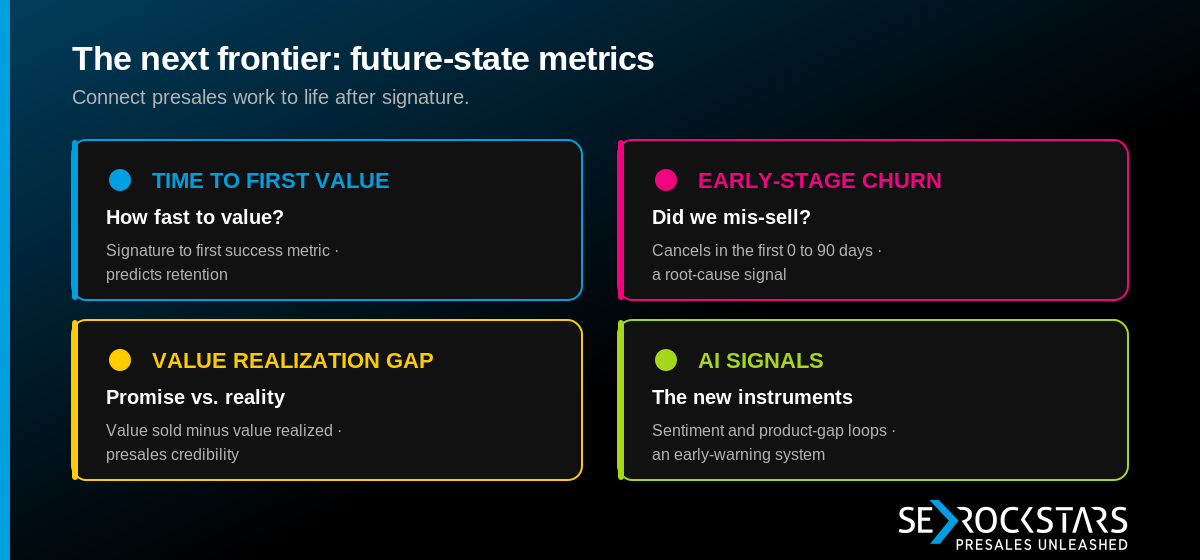
Time to First Value (TTV) — calendar days from signature to the customer hitting the first agreed success metric. Fast TTV correlates with retention and expansion. Slow TTV is rarely an implementation problem alone; more often it exposes vague success criteria, a weak handoff, or unrealistic integration assumptions baked in during the sales cycle. Segment it by product and complexity, and feed it back into discovery — not into an individual SE's scorecard.
Early-Stage Churn (0–90 days) — the share of new customers who cancel inside the first 90 days. This is the brutal one. Churn this early almost never originates in onboarding; it originates in the deal. Weak qualification, expectations set too high to clear, a solution scoped for a demo rather than a deployment. Read it alongside TTV and handoff quality and you can usually pinpoint the root cause: was it what was sold, how it was handed over, or how slowly value arrived?
Product Gap Identification & Resolution — how reliably SEs capture real product deficiencies from live deals (with business impact, frequency, segment, competitive context) and how reliably Product/R&D dispositions them. This turns scattered field frustration into an accountable improvement loop. The payoff is concrete: at one US company we worked at, EU data-privacy and compliance requirements — SOC 2, TISAX, GDPR — stalled deal after deal. Only once we tracked every opportunity where they surfaced and tied it to pipeline impact did the story land with product leadership. Compliance features got reprioritized, and the region started closing.
Value Realization Gap — the difference between the value PreSales promised to win the deal and the value Customer Success measures 6 to 12 months later. More on this one below, because it's the keystone.
The Value Realization Gap: your credibility, measured
Here's the uncomfortable definition. You build a business case to win a deal — an ROI model, a payback period, a "you'll save X" headline. The Value Realization Gap asks: how much of that actually happened?
A persistent positive gap — promised far more than landed — is a flashing signal of overpromising, flawed value models, or outcomes that were never scoped to be achievable. A low gap means your value engineering was accurate, and accurate value engineering produces healthier customers who renew and expand. There is no metric in this entire series that speaks more directly to whether PreSales is trusted or merely tolerated.
This is also where a lot of technical teams quietly lose. One SE manager at a cybersecurity company in the DACH region named the pattern precisely:
"Our teams are technically very strong due to their background, but they very quickly fall into a default demo mode or default POC mode. That works fine on the admin and IT side, but at the C-level I would like us to talk more about business outcomes and business value, to create the trusted advisor perception with the customer."
That demo-mode default is the upstream cause of a wide Value Realization Gap. If the deal was won on features rather than a defensible business outcome, there's no value model to realize against — and nothing CS can hold up at the QBR. The gap doesn't open at implementation. It opens the moment a deal is sold on capability instead of outcome.
A practical note: you don't sell this metric to an SE as a number to hit. You can't bonus someone on a figure measured a year later by a different team — you'll just teach them to lowball the business case at presales to keep the gap flattering. Use it the way PreSales Unleashed uses it on its own engagements: a status-quo baseline at the start, then a quarterly check on actual impact with the leader. It's a truth instrument for the function, not a stick for the individual.
What about AI? Sentiment as an early-warning signal
The newest entry is AI-Driven Sentiment Analysis — conversational-intelligence tools scoring emotional tone and engagement across calls: talk-to-listen ratio, monologues and interruptions, sentiment shifts when pricing or competitors or implementation come up. Done well, it turns "manager gut feel" into a consistent signal and surfaces hidden risk — hesitation, anxiety, cooling sentiment — even when the CRM still looks green.
There's real appetite here, and real anxiety underneath it. As a founder at an IT services and systems-integration firm in the UK put it:
"If you could give everyone a magic wand so they could see what their processes would look like in 3 years' time with AI now and adapt faster, then everybody would snap your arm off for that, because there's so much uncertainty. Any certainty that you can give people around this is definitely the way it's going."
The certainty AI sentiment can offer is narrow but useful: an earlier, more consistent read on deal health. The trap is treating the score as a verdict. It's an input to a coaching conversation, best combined with deal stage, stakeholder coverage, and technical-milestone data — not a replacement for them, and certainly not a substitute for an SE actually preparing for the call. Use it to ask better questions, not to stop asking them.
A concrete example
A mid-market SaaS team runs the experiment for one quarter, top 25 new logos only. They tag each deal's presales business case (the promised annual saving) in the CRM, set a single shared TTV success metric per deal, and ask CS to log realized value at month six.
Six months later the picture is uneven. Technical Win Rate on the cohort was a healthy 71%. But average TTV ran 94 days against a promised 30, three accounts churned inside 90 days, and the Value Realization Gap averaged 38% — customers landed barely over a third of the promised saving.
The activity dashboard would have called this a great quarter. The future-state lens caught the leak: every churned account shared a slow TTV and a business case built on a feature list rather than a quantified outcome. The fix wasn't more demos. It was tighter success criteria in discovery and a real value model before contract — a PreSales fix, surfaced only because someone measured past the signature.
Frequently asked questions
What is the Value Realization Gap in PreSales? It's the difference between the value PreSales promised to win a deal — the ROI or business case — and the value Customer Success actually measures 6 to 12 months later. A large gap signals overpromising or flawed value models; a small gap signals accurate value engineering and healthier, expanding customers. It's the strongest single signal of PreSales credibility.
Should I hold individual SEs accountable for early churn or TTV? No. These are cross-functional outcome metrics shaped by onboarding, product, and implementation as much as by the deal. Use them as root-cause signals at the team and process level. Bonusing an individual SE on a number measured a year later by another team only teaches them to game the inputs.
How do I start measuring future-state metrics without perfect data? Pick a narrow scope — one segment or your top accounts — and accept proxies. Tag the presales business case in the CRM, agree one TTV success metric per deal, and have CS log realized value once. Improve data quality over time. Waiting for a clean pipeline means never starting.
Can AI sentiment analysis replace manager judgment on deal health? No. It's an early-warning input, not a verdict. Sentiment scoring surfaces hesitation or cooling engagement that the CRM hides, but it's only useful combined with deal stage, stakeholder coverage, and technical milestones — and it never replaces an SE's own preparation and reading of the room.
This is Part 9 of a 10-part series on PreSales performance measurement, drawn from the PreSales KPI Playbook and hundreds of conversations with solution engineering leaders. The Trusted Advisor Academy helps PreSales teams turn frameworks like this into everyday practice — including the cross-functional, value-led habits these future-state metrics depend on.
About the authors: Tim Brömme and Jan-Erik Jank are the co-founders of SE Rockstars and the Trusted Advisor Academy. Between them they bring 30+ years of enterprise PreSales experience, eight-figure closed deal portfolios, and 350+ solution engineers coached.
This isn't just a training. It's rewiring how your team operates.
100% free | No commitment required




.svg)