
KPI Pairing & Integrity: Don't Let One Number Wreck the System


TL;DR
- Any KPI you optimize in isolation will get gamed — not because your team is dishonest, but because that's what optimization is. Intel's Andy Grove called this out decades ago.
- The fix is pairing: every "effect" metric (more, faster, busier) gets a counter-metric that captures the downside it would otherwise hide.
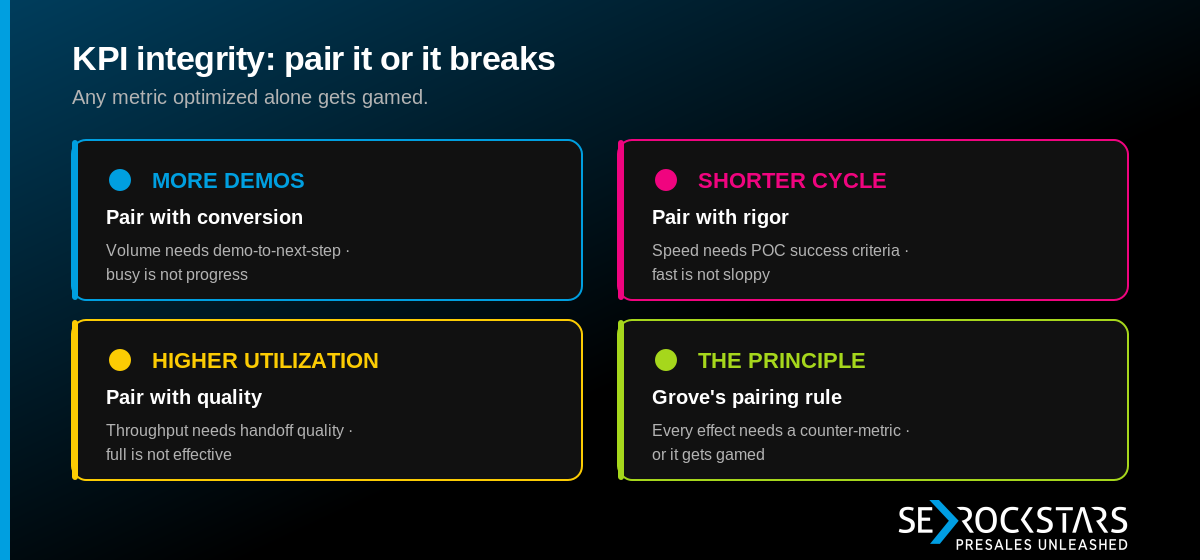
- More demos pairs with demo-to-next-step conversion. Shorter cycle time pairs with POC success-criteria coverage. Higher utilization pairs with handoff quality.
- The most dangerous setup is a single number tied to comp. When "only the numbers count," everything the number doesn't capture quietly rots.
- Integrity isn't a moral add-on to your KPI system. It's a structural property — and pairing is how you build it in.
"In our self-organized setup, only the numbers count — it's brutal," an SE manager at a cybersecurity company in the DACH region told us. "KPIs get set, but in reality nobody follows through on them 100% seriously. In the end the only thing that truly matters is what ends up in the wallet." He wasn't describing a broken team. He was describing a team behaving exactly as designed: when one number — revenue — controls the wallet, every other number becomes theater.
That's the trap this whole piece is about. You can build the most thoughtful KPI framework in the world, and a single unpaired metric tied to incentive will hollow it out from the inside. So before you add another dashboard, you need a rule for how metrics behave once people start optimizing them. That rule is pairing.
Why does optimizing one KPI break the system?
Because a metric is a proxy, and people optimize the proxy, not the thing it stands for. Andy Grove, who built Intel's operating discipline, warned that any measure you choose will shape behavior — and if you measure only one side of an outcome, your team will move that number in ways that quietly damage the business. Not through malice. Through incentive.
Tell an SE team "do more demos" and you'll get more demos — including demos that should have been a qualifying call, demos run for tire-kickers, demos that inflate the count and starve the deals that mattered. Tell them "shorten the sales cycle" and watch POCs get declared successful before the success criteria were actually met. Every metric has a shadow: the behavior it accidentally rewards. Measure only the bright side and the shadow grows unchecked.
This is why "we hit the number" can coexist with "the quarter fell apart." The number was never the goal. It was a stand-in for the goal, and the stand-in got gamed.
Grove's answer: pair every effect with a counter-effect
Grove's fix was elegant and almost mechanical. For every KPI you introduce — the effect you want — you introduce a second metric that captures its likely downside — the counter-effect. The pair sits together, permanently. You never report one without the other.
The logic: a counter-metric makes gaming visible. If demo volume climbs while demo-to-next-step conversion falls, you haven't gotten more productive — you've gotten busier at producing nothing. The pair tells you that in one glance. A single metric would have let you celebrate.
Here's what that looks like in a PreSales context, where the temptation to chase volume and speed is constant:
- More demos delivered — Counter-metric (the downside it hides): Demo-to-next-step conversion · What the pair protects: Demos that actually advance deals, not vanity volume
- Shorter sales-cycle time — Counter-metric (the downside it hides): POC success-criteria coverage · What the pair protects: Speed that comes from real validation, not corners cut
- Higher SE utilization — Counter-metric (the downside it hides): Handoff quality to post-sales · What the pair protects: Busy SEs who don't dump half-finished deals downstream
- Higher demo / PoC throughput — Counter-metric (the downside it hides): Technical Win Rate on those deals · What the pair protects: Throughput onwinnabledeals, not just any deal
- Faster qualification — Counter-metric (the downside it hides): False-disqualification rate / re-opened deals · What the pair protects: Speed that doesn't throw away real pipeline
Read each row left to right and the discipline becomes obvious. The left column alone is a gaming invitation. The pair is a system that defends itself.
The most dangerous metric is the one tied to comp
There's a special category of unpaired metric, and it's the one that does the most damage: the single number wired straight to compensation.
When the SE manager above said "only the numbers count," he was describing a 100%-revenue comp model. No room for leading indicators, no weight on quality, no counter-metric — just the wallet. He knew the cost, and he'd done the math on the fix: "I would have preferred a mix: maybe 25% self-driven and another 10% KPI-driven. Unfortunately that's not how it works for us."
That instinct is exactly right, and it's the same instinct as Grove's. A pure revenue comp is the ultimate unpaired KPI. It rewards closing and is blind to how the deal closed — whether the SE actually secured the Technical Win or just rode an inevitable deal, whether they set up the next renewal or scorched the relationship to hit the number this quarter. Pairing at the comp level means revenue stops being the only thing in the wallet. The counter-effects — technical win quality, handoff health, leading-indicator hygiene — get a seat at the table where it actually matters: the payout.
Integrity isn't honesty. It's interpretability.
Here's the second failure mode, and it's quieter than gaming. A metric can be perfectly un-gamed and still be useless — because nobody trusts what it means.
An SE manager at a vertical SaaS company in the DACH region described exactly this: "The projected revenue figure given to us by the revenue team is basically a black box. This sometimes leads to a lot of internal debate — you have two mid-market customers, both at 40 million, one is at 300,000 and the other at 400,000, and you simply can't understand why." Nobody is gaming that number. It's just opaque, and opacity is its own integrity failure. A KPI you can't interpret can't drive behavior — it only drives argument.
Pairing helps here too, but the deeper principle is this: a metric has integrity when the team can see why it moved. A counter-metric gives a number context, and context is what makes it legible. "Demos up 30%" is a black box. "Demos up 30%, conversion flat" is a story everyone can read the same way.
Don't let integrity tip into surveillance
One caution, because pairing can be taken too far. The point of a counter-metric is to protect the system, not to wire every individual to a polygraph.
An SE manager at a developer-tools company in North America named the line clearly: "If we start having individual tracking, it can turn from a valuable learning opportunity into a micromanagement tracking exercise." That's the failure mode on the other side of the ledger. Pile up enough individual-level counter-metrics and you've built surveillance, not integrity — and a surveilled team games harder, because now the metric is a threat, not a mirror.
So pair at the level of the system and the team, not the individual keystroke. Counter-metrics exist to keep the machine honest — to make sure "more" and "faster" aren't quietly destroying "better." They're a design feature of the scorecard, not a stick. Used that way, pairing actually reduces the urge to micromanage, because the system catches distortion structurally instead of forcing managers to police it by hand.
How to put pairing into practice
You don't need to re-architect everything. You need one rule and a short audit.
The rule: never ship a volume or velocity metric without a quality or outcome metric beside it. If a dashboard has a number that only goes one direction to look "good," it's unpaired, and it's a gaming risk. Pair it or pull it.
The audit: list every KPI currently tied to reporting or comp. For each one, ask: if someone optimized only this, in the laziest possible way, what would break? That broken thing is your counter-metric. Demos → conversion. Cycle time → POC criteria coverage. Utilization → handoff quality. Write the pair down. Report them together, always.
Do that, and the metrics stop being something your team works around and start being something that works for them. That's the whole game: a scorecard with enough internal tension that no single number can wreck the system.
Frequently asked questions
What is KPI pairing? KPI pairing means attaching a counter-metric to every "effect" metric you track. The effect metric captures what you want more of (demos, speed, utilization); the counter-metric captures the downside that chasing it would otherwise hide (conversion, success-criteria coverage, handoff quality). You report and review the pair together, never one alone.
Why do single KPIs get gamed? Because a metric is only a proxy for the real goal, and people optimize the proxy. Intel's Andy Grove observed that any measure you pick shapes behavior — measure one side of an outcome and teams will move that number in ways that quietly damage the business. It's incentive, not dishonesty, and pairing is the structural fix.
What should I pair PreSales metrics with? More demos pairs with demo-to-next-step conversion. Shorter sales cycles pair with POC success-criteria coverage. Higher utilization pairs with handoff quality to post-sales. Higher throughput pairs with Technical Win Rate on those same deals. The counter-metric is always the thing that would break if someone optimized the headline number lazily.
Does pairing mean tracking everything about every SE? No — and that's the trap to avoid. Pair at the level of the system and the team, not the individual keystroke. Over-instrumenting individuals turns a learning tool into surveillance, which makes people game harder. Counter-metrics exist to keep the machine honest, not to police every person.
This is Part 7 of a 10-part series on PreSales performance measurement, drawn from the PreSales KPI Playbook and hundreds of conversations with solution engineering leaders. The Trusted Advisor Academy helps PreSales teams turn frameworks like this into everyday practice — including building KPI systems that hold up once people start optimizing them.
About the authors: Tim Brömme and Jan-Erik Jank are the co-founders of SE Rockstars and the Trusted Advisor Academy. Between them they bring 30+ years of enterprise PreSales experience, eight-figure closed deal portfolios, and 350+ solution engineers coached.

This isn't just a training. It's rewiring how your team operates.
100% free | No commitment required





.svg)