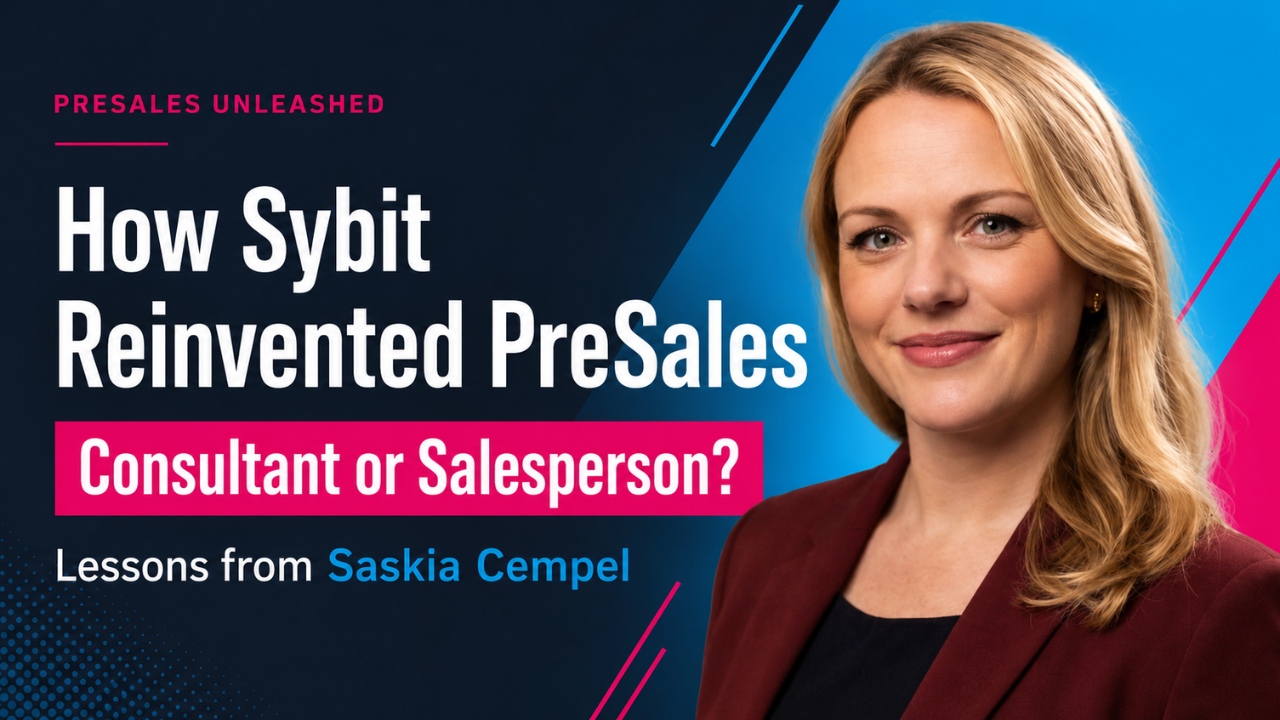

Consultant or Salesperson? How Sybit Reinvented PreSales — and Why They'd Never Go Back
Saskia Cempel, PreSales Team Lead at SAP partner Sybit, shares the playbook for splitting the Solution Consultant and PreSales roles — from the triggers that started the change to the measurable impact on customer trust.
The Starting Point: One Person, Two Jobs
For years, Sybit — a mid-market SAP partner with a consulting team of roughly 250 people — ran a setup that will sound familiar to most IT service providers: Solution Consultants handled both project implementation and presales. The same person who built the system also had to sell it.
Saskia Cempel lived this firsthand. When she joined Sybit over seven years ago, her role was a classic hybrid: building system and process concepts, running workshops, customizing SAP solutions (Sales Cloud, Field Service Management), and supporting sales on the side — whenever project work allowed it.
"I'd say it was roughly 40% presales and 60% project work. But the project always had priority. When sprint deadlines hit, presales took the back seat." — Saskia Cempel, PreSales Team Lead, Sybit
The problem wasn't that the work was bad. It was that no one could fully commit to either role. Sales cycles are unpredictable and spontaneous; project delivery is structured and plannable. Combining both meant neither got the attention it deserved.
Why Sybit Decided to Split the Roles
The trigger wasn't a single event — it was a growing realization that presales had become too important to run as a side job. Several factors came together:
- Rising complexity of the presales function: PreSales at Sybit doesn't just support sales opportunities. The team interfaces with marketing, event management, SAP itself, and parent company NTT DATA. Running all of that as a part-time responsibility became unsustainable.
- The need for true specialization: SAP constantly releases new products, features, and updates. Sybit wanted their presales team to be the first to know about every release highlight — acting as genuine Trusted Advisors rather than generalists splitting their attention.
- Pipeline dependency: Without a strong presales engine, the 250-person consulting team would eventually run out of projects. PreSales became the growth bottleneck that needed dedicated investment.
How They Structured It: PreSales Without a Sales Quota
Here's where Sybit made an unconventional choice: the presales team sits organizationally within consulting, not sales. They carry no sales quota. Their targets mirror those of Solution Consultants — individual development goals and productivity metrics, not revenue numbers.
"We deliberately chose not to align our incentives with sales targets. If we had the same commission structure as the sales reps, I believe our advisory quality would eventually suffer. You'd start pushing for the close instead of giving honest counsel." — Saskia Cempel
This structural decision enables a healthy tension between sales and presales. The Account Executive naturally pushes to close deals. The presales team can push back — flagging risks, questioning scope, and raising concerns about project feasibility — without a personal financial incentive to stay quiet.
Externally, the team brands itself as "Solution Advisors" — reinforcing the trusted-advisor positioning rather than a sales-adjacent role.
The Handoff: Standardizing the PreSales-to-Project Transition
Splitting roles creates a seam — the moment when presales hands the deal to the project team. Sybit addressed this head-on:
Key Process Changes
- Formalized PreSales Request: Sales reps can't just pull presales resources informally. There are defined criteria for when presales engagement is warranted, tracked systematically in the CRM.
- Standardized Handover Templates: Co-developed with project managers, these templates ensure nothing falls through the cracks when transitioning from sales to delivery.
- Joint Scoping Discussions: Before engaging, Saskia and her sales counterpart discuss each case: How much effort do we invest? Do we go with a highly customized approach or leverage standard assets?
- Soft Transition Period: PreSales stays involved through the first project kickoffs. In 95% of cases, the project team takes over fully after that — but the door remains open.
The Talent Question: Who Thrives in a Pure PreSales Role?
Not everyone wants to give up the hybrid role. Many consultants genuinely enjoy the variety of doing both presales and implementation. Saskia is pragmatic about this:
"My goal is to have 100% dedicated presales people. But I still have team members who do both roles — as long as they can make the mental switch. When you're in presales mode, you discuss differently than when you're in project delivery mode." — Saskia Cempel
Interestingly, about 80% of Saskia's current team did not come from Solution Consulting backgrounds. They came from Business Development, sales roles at other companies, or entirely different functions. The advantage: they don't carry "the curse of knowledge" — the tendency to dive into implementation-level detail when the customer only needs to feel confident that the problem can be solved.
The Core Distinction: Convincing vs. Solving
This is arguably the most important insight from the conversation:
PreSales ≠ Problem-Solving
If you're solving the customer's problem in presales, you're already doing it wrong. The actual problem-solving happens in project implementation. PreSales has one job: convince the customer that your organization can solve the problem. It's persuasion, not solution delivery.
This distinction is easy to state but hard to practice — especially for people who've spent years deep in SAP system configuration. The temptation to show every technical detail is real. But the audience has shifted: today's presales conversations are increasingly with business stakeholders (heads of sales, service directors, digitalization leads) rather than IT departments. These decision-makers don't care how it's solved — they care that it can be solved.
The Enablement Framework
Sybit didn't just split the roles — they built a proper career path and training program:
- Full technical foundation: Every presales hire goes through the same training as Solution Consultants first, ensuring system familiarity.
- Presales-specific skills: On-camera presentation coaching (especially valuable post-COVID), voice training ("Voice of Success" workshops), and process consulting certifications (e.g., Signavio modeling).
- Explicit role matrix: PreSales has its own defined career levels, parallel to — but distinct from — the Solution Consultant track.
- Cross-team "internships": New consultants spend time shadowing presales cases to understand the reality of working with limited information and tight timelines.
The Numbers: A Lean Machine
Sybit runs its presales function with just 5 dedicated people supporting a consulting organization of ~250. That's a ratio of roughly 1:50. They cover 80–90% of all presales engagements internally; for highly technical or overflow situations, they pull in specialized consultants from the broader team or leverage Sybit's competence centers.
Deal sizes range from €50,000 to several hundred thousand euros (ACV), with sales cycles spanning 3 months to over a year.
The Customer Impact
The clearest validation comes from the customers themselves:
"The biggest proof that we've done something right is when the customer asks: 'Ms. Cempel, what role will you play in the project?' They've experienced so much value in presales that they want to keep us involved in delivery." — Saskia Cempel
Customers have also become more advisory-hungry. Where buyers once arrived with detailed requirements documents, today they often come with a vague idea or a business problem — and need guidance on how to get from A to B. The dedicated presales role is built to serve exactly this shift.
Should You Split PreSales and Solution Consulting?
Saskia's advice for organizations considering the split:
- Start with a pilot. Before creating a formal team, identify 2–3 consultants who already gravitate toward presales work. Let them run presales-only for a while and see what happens.
- Check organizational fit. Does this align with your company's goals? Do you have people who genuinely want to do 100% presales?
- Consider the utilization question. Can you keep a dedicated presales person fully utilized? If your deal volume doesn't support it, the hybrid model may still be the right fit.
- Iterate, don't revolutionize. Sybit ran a few people in a de facto presales role before officially creating the team. Test the model, identify challenges, and adjust before going all-in.
Saskia's Bottom Line
"For us, this is clearly the model that works. I would never go back. But I wouldn't say it's the right model for every company. It depends on your goals, your people, and your scale."
Key Takeaways
- PreSales is persuasion, not implementation. The moment you start solving the customer's problem in presales, you've gone too far.
- Separating incentives protects advisory quality. Sybit's presales team has no sales quota — by design.
- Most great presales people don't come from consulting. Business development and sales backgrounds often work better because they don't over-index on technical detail.
- Formalize the handoff. Standardized presales requests and handover templates are non-negotiable when you split roles.
- Start small, iterate. Run a pilot before building a full team structure.




.svg)